

Competitive tactical shooting is not built on talent alone. It is built on repetition, discipline, and structured training. While some shooters may seem naturally skilled, most competitors earn their results through consistent range time and focused skill development.
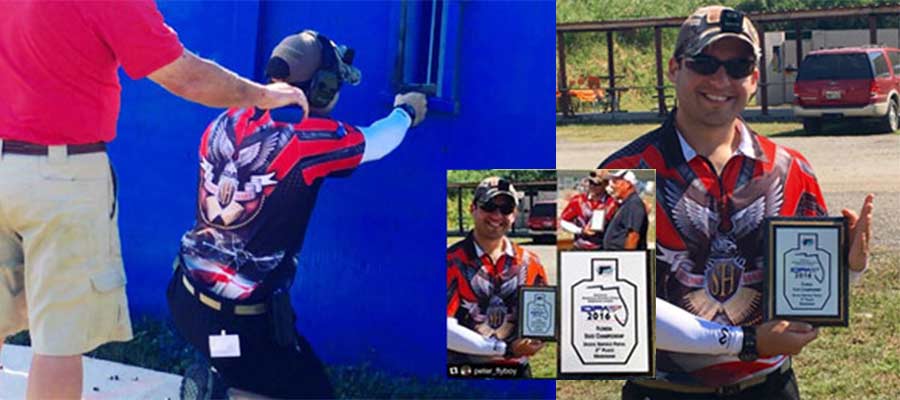
That path is exactly what led Peter Lozano to become one of Miami’s newest recognized sharpshooters. After purchasing his first firearm at 21, Lozano shot occasionally, visiting the range only a few times per year. Nearly a decade later, he committed to improving his performance. That decision quickly translated into measurable results.
Within a single month, Lozano placed second in the Florida State Championship Stock Service Pistol Division of the International Defensive Pistol Association (IDPA) and earned first place in the Production category at a local match hosted by the United States Practical Shooting Association (USPSA). During that same period, he advanced from the Marksman classification to Sharpshooter within IDPA.
Originally from Lima, Peru, Lozano has lived in Miami since 1995 and works professionally as an airline pilot. His turning point came after attending Tactical Nights at Stone Hart’s Gun Club & Indoor Range. These dynamic training sessions provided structured movement, timed drills, and real-world stage scenarios not commonly available at traditional ranges in South Florida.
According to Lozano, Tactical Nights offered an opportunity to practice skills that are difficult to replicate elsewhere in Miami while still maintaining a controlled and safety-focused environment. That foundation translated directly into improved match performance.
A fellow competitor later introduced him to IDPA competition. Despite the organization’s strict enforcement of safe gun handling rules, Lozano performed confidently and qualified for state-level competition. The consistent dynamic practice at Stone Hart’s played a significant role in that success.
Equipment and Preparation Matter
For competition, Lozano selected a Glock 34 configured with upgraded sights and custom trigger work completed by in-house gunsmith Steve Schack at Stone Hart’s. His ammunition preference was Federal American Eagle 147 grain, chosen over 115 grain for its softer recoil impulse and faster follow-up shot capability.
Preparation extended beyond live fire. Lozano incorporated approximately twenty minutes of dry fire practice each evening using snap caps. In the six weeks leading up to competition, he intensified his training schedule despite balancing work and family life with three young children at home. The additional repetition and structured practice made the difference, allowing him to outperform shooters with significantly more years in the sport.
How to Get Started in Tactical Shooting in Miami
For shooters interested in entering tactical competition, Tactical Nights at Stone Hart’s Gun Club provide an accessible starting point. These sessions are typically held on the second-to-last Wednesday of each month. The evening begins with a mandatory safety briefing at 6:45 PM, followed by live stages starting at 7:00 PM.
Participation requirements include:
- An approved outside-the-waistband holster
- A double magazine pouch
- At least three magazines
- Rapid Fire and Holster qualification
The Rapid Fire and Holster qualification can be completed at the range for a one-time fee. Tactical Nights are open to both members and non-members, making them an ideal entry point for those looking to test their skills in a structured competitive environment.
Competitive shooting demands focus, safety, and consistent training. For Miami-area shooters who want to move beyond static lane practice and develop real match-ready skills, structured dynamic sessions can accelerate improvement significantly.
FAQ: Tactical Shooting & Competition in Miami
What is the difference between IDPA and USPSA?
IDPA emphasizes defensive scenarios and practical carry equipment, with strict procedural rules. USPSA focuses more heavily on speed and stage efficiency, often allowing more equipment customization.
Do I need prior competition experience to attend Tactical Nights?
No. However, you must meet safety and holster qualification standards before participating in dynamic drills.
Is a Glock 34 required for competition?
No. Many firearms are competition-legal depending on division rules. The Glock 34 is popular due to its longer sight radius and recoil characteristics.
How important is dry fire practice?
Extremely important. Dry fire builds trigger control, sight alignment habits, and draw consistency without ammunition cost.
Can beginners realistically become competitive?
Yes. With structured training, consistent practice, and attention to safety fundamentals, new shooters can progress through classification levels effectively.
For more details about Tactical Nights, training qualifications, and upcoming sessions, contact Stone Hart’s Gun Club & Indoor Range at (305) 255-4884.